
 Landline Number
 pvgcoenashik@
About Department
The Department of Information Technology was established in the year 2010 with an initial sanctioned intake of 60 students. From the academic year 2025–26, the intake has been increased to 120 (branch code: 533024610), reflecting the growing demand for IT education and careers.
The department provides state-of-the-art infrastructure and is supported by a team of highly qualified and dedicated faculty. Our focus is on nurturing students to become competent, ethical, and future-ready professionals in the dynamic world of Information Technology.
Information Technology refers to the use of computing systems, including hardware, software, networking, the Internet, and the professionals who manage and develop these technologies. Over the years, the scope of IT has expanded significantly, becoming a crucial component across all sectors.
IT professionals handle a wide range of tasks from installing and maintaining applications to designing complex networks and managing vast databases.
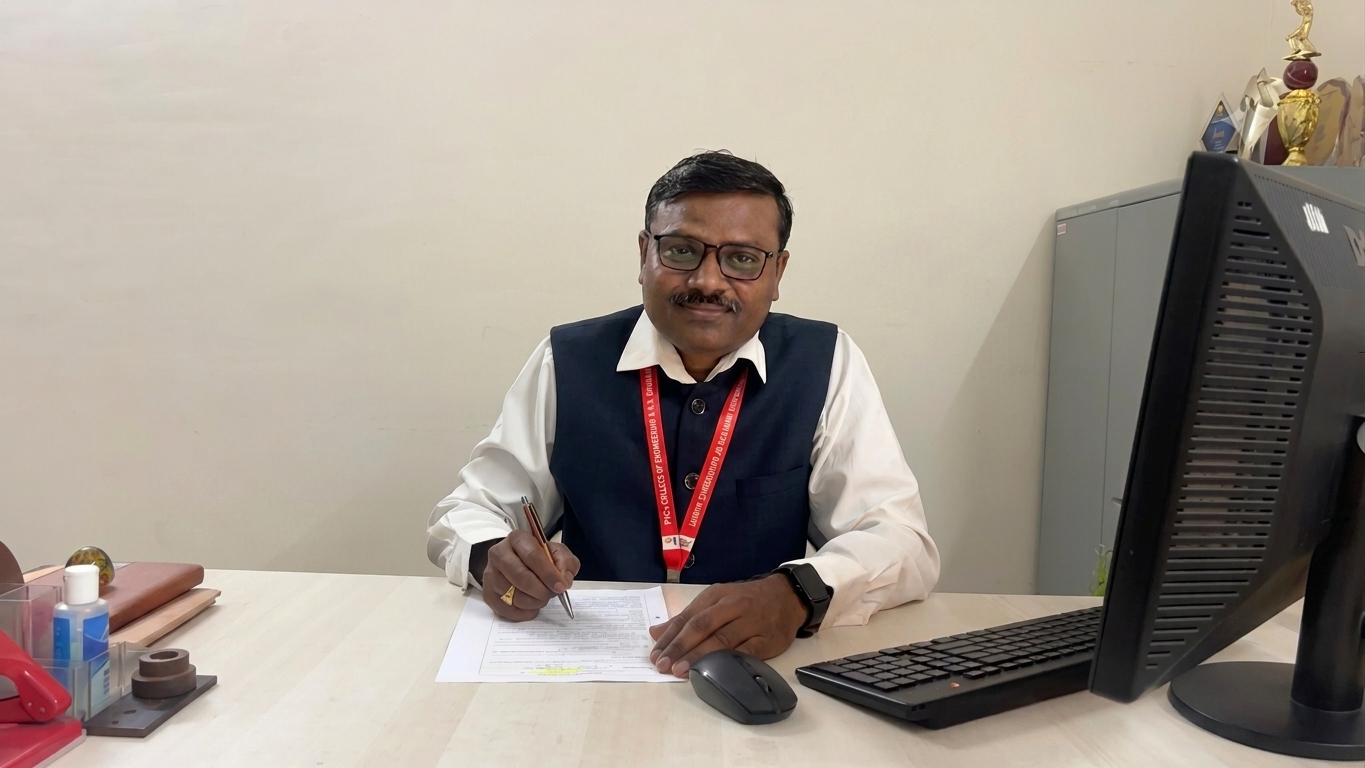
Dr. Shivaji R. Lahane
(Associate Professor & Head of Department)
VISION
- To achieve the excellence in the development of IT solutions.
MISSION
- To provide theoretical and practical knowledge according to recent trends in information technology.
- To develop student as IT professional for employment and self employment by technical knowledge, communication skills and social environment.
- To motivate students to make use of IT solution for all classes of the society.
Program Outcomes (PO)
- PO1: Engineering Knowledge: Apply knowledge of mathematics, natural science, computing, engineering fundamentals and an engineering specialization as specified in WK1 to WK4 respectively to develop to the solution of complex engineering problems.
- PO2: Problem Analysis: Identify, formulate, review research literature and analyze complex engineering problems reaching substantiated conclusions with consideration for sustainable development. (WK1 to WK4)
- PO3: Design/Development of Solutions: Design creative solutions for complex engineering problems and design/develop systems/components/processes to meet identified needs with consideration for the public health and safety, whole-life cost, net zero carbon, culture, society and environment as required. (WK5)
- PO4: Conduct Investigations of Complex Problems: Conduct investigations of complex engineering problems using research-based knowledge including design of experiments, modelling, analysis & interpretation of data to provide valid conclusions.(WK8).
- PO5: Engineering Tool Usage: Create, select and apply appropriate techniques, resources and modern engineering & IT tools, including prediction and modelling recognizing their limitations to solve complex engineering problems. (WK2 and WK6)
- PO6: The Engineer and The World: Analyze and evaluate societal and environmental aspects while solving complex engineering problems for its impact on sustainability with reference to economy, health, safety, legal framework, culture and environment. (WK1, WK5, and WK7).
- PO7: Ethics: Apply ethical principles and commit to professional ethics, human values, diversity and inclusion; adhere to national & international laws. (WK9)
- PO8: Individual and Collaborative Team work: Function effectively as an individual, and as a member or leader in diverse/multi-disciplinary teams.
- PO9: Communication: Communicate effectively and inclusively within the engineering community and society at large, such as being able to comprehend and write effective reports and design documentation, make effective presentations considering cultural,language, and learning differences
- PO10: Project Management and Finance: Apply knowledge and understanding of engineering management principles and economic decision-making and apply these to one’s own work, as a member and leader in a team, and to manage projects and in multidisciplinary environments.
- PO11: Life-Long Learning: Recognize the need for, and have the preparation and ability for i) independent and life-long learning ii) adaptability to new and emerging technologies and iii) critical thinking in the broadest context of technological change. (WK8).
Program Specific Outcomes (PSO)
- PSO1: An ability to apply the theoretical concepts and practical knowledge of Information Technology in analysis, design, development and management of information processing systems and applications in the interdisciplinary domain.
- PSO2: An ability to analyze a problem, and identify and define the computing infrastructure and operations requirements appropriate to its solution. IT graduates should be able to work on large-scale computing systems.
- PSO3: An understanding of professional, business and business processes, ethical, legal, security and social issues and responsibilities.
- PSO4: Practice communication and decision-making skills through the use of appropriate technology and be ready for professional responsibilities.